Shire project details
Identification of the structural typology and the specific attributes of cultural heritage
In the initial phase of the research, methods for synthesizing and evaluating existing data will be applied. This data will be collected through a review of existing databases to establish a clearer research focus. To limit the scope of the study, the typology of masonry buildings examined will be restricted to churches and representative residential complexes of noble and ruling families. The initial survey and categorization of the buildings will be carried out based on the data available in the Register of Cultural Property of the Republic of Croatia and the Geoportal of Cultural Property of Croatia. In addition, archival documentation will be collected from the relevant conservation departments, state archives, the Croatian Institute for Conservation, the Institute for Art History, the Institute for the Restoration of Dubrovnik, local diocesan archival sources, as well as scientific research and other available sources.
After the initial systematization, the selected group of buildings will be categorized according to typological features — such as floor plan shape, structural elements of vaults, domes, etc. — as well as the level of protection and other significant historical and artistic attributes, which will be defined during the systematization process. Based on their connection to the structure, the classification will be applied according to:
A – Structural elements of the building (e.g. vaults of various shapes, portals and arches),
B – Historical and artistic elements that are rigidly connected to the structure (e.g. rosettes, pilasters, frescoes, stained glass),
C – Freestanding elements connected to the structure (e.g. sculptures, reliefs, balustrades).
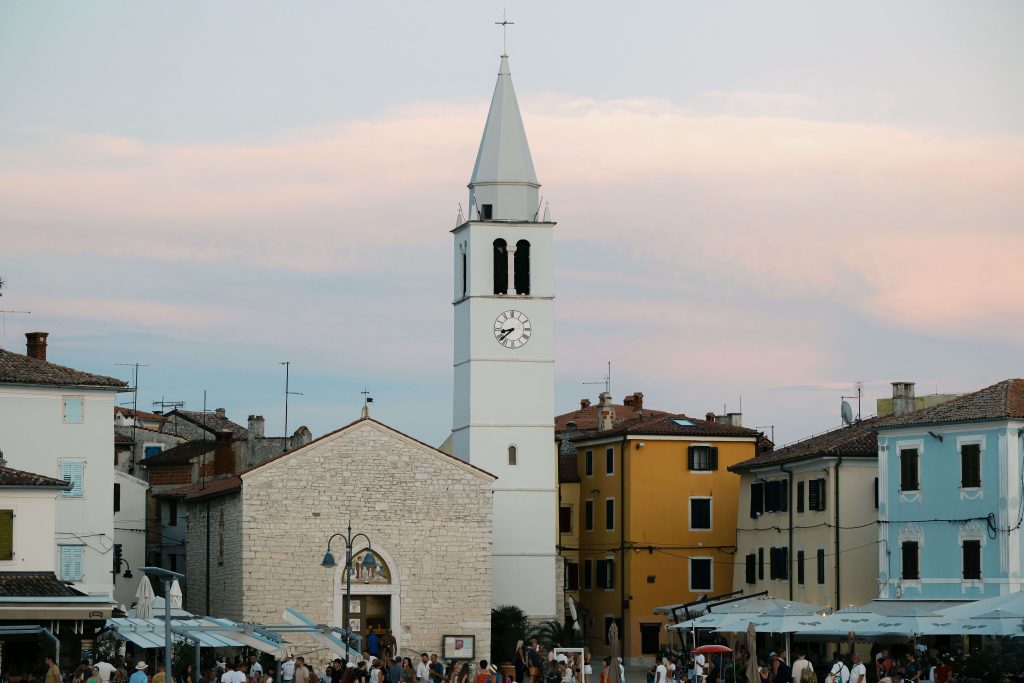
Damage patterns categorization
An important part of the overall research methodology is the categorization of the damage, which refers both to the structural elements in terms of their load-bearing capacity and safety and to the extent of the physical damage that requires restoration works. The database of damaged buildings (CCEE database) and the 3D documentation of damaged cultural properties (Ministry of Culture and Media), for which the necessary permits have been obtained, as well as other relevant sources will be examined. The qualification of the damage will be based on the degree of structural damage and the damage affecting the values of the cultural heritage, which are divided into three categories according to the classification. For this purpose, existing guidelines with a methodological approach to damage assessment and quantification will be used as a reference, primarily the Form for the Assessment of Earthquake Damage to Cultural Heritage and the ICOMOS-ICCROM document.
Since some of the activities relate to the classification of heritage values and specific damage patterns fall within the expertise of conservators and restorers, it is important to educate all members of the research team about the factors that influence historical authenticity, artistic value and spatial functionality. To meet this need, a symposium on “Heritage Values of Historic Masonry Buildings in the Republic of Croatia” will be organized in the first year of the project. The symposium will feature prominent Croatian conservators, restorers and key stakeholders in heritage management as speakers. The event will facilitate networking between the research team and relevant heritage stakeholders and ensure the establishment of criteria for the quantification of physical damage to elements of outstanding heritage value.
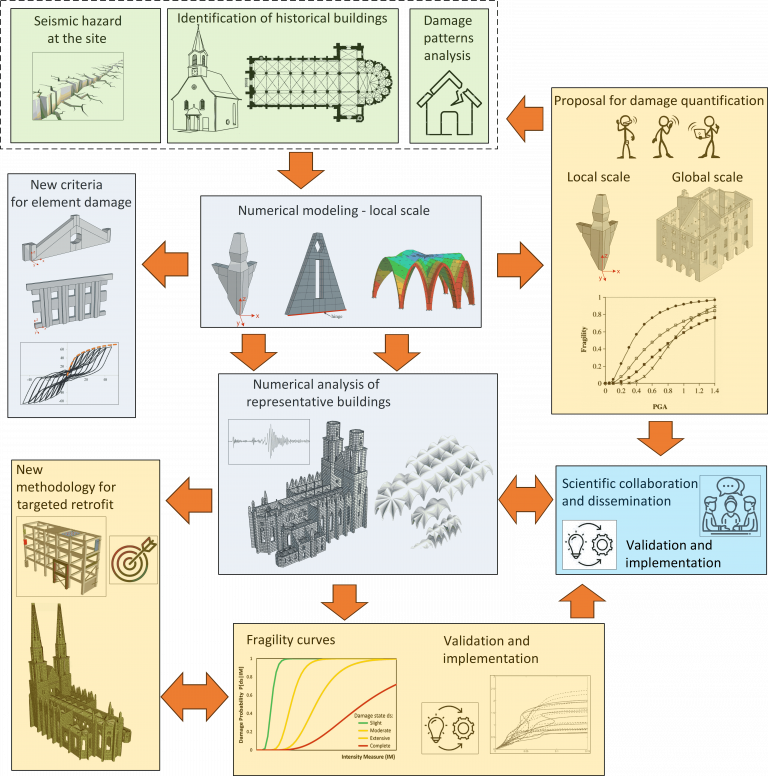
Overview of strengthening measures
The research will explore restoration and strengthening measures for cultural heritage buildings, drawing primarily on the experience of the Institute for the Restoration of Dubrovnik and the reconstruction process following the earthquakes in Zagreb and Petrinja. Special emphasis will be placed on the systematization of new technological strengthening solutions based on the latest research results. Particular attention will be given to the invasiveness of specific interventions as well as to the recommendations of the ISCARSAH-ICOMOS guidelines and their implications for improving the seismic resilience of structures. This systematization will also consider localized strengthening measures, particularly those that could significantly reduce the damage to historical and artistic elements due to low-intensity earthquakes, as well as those that contribute to the overall seismic safety of the structure.
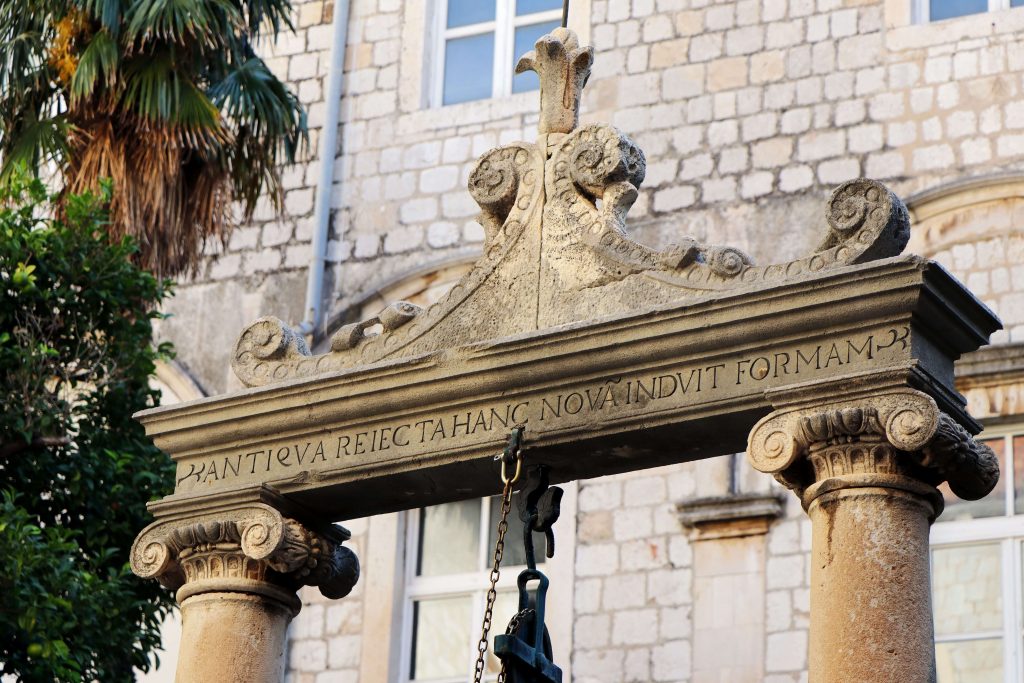

NUMERICAL MODELING PROCESS
Multiscale numerical modelling is at the core of the project proposal and will be progressively implemented through a systematic approach to develop numerical models of varying complexity to ensure reliable seismic vulnerability assessments of cultural heritage buildings. The modelling methodology is based on the use of different numerical methods, applying methodological approaches such as continuum models based on the finite element method (CM), macroelement models (MEM), macroblock models (MBM) with the application of kinematic limit analysis and detailed numerical models based on discrete block modelling and interfaces (DIM). Nonlinear static analysis and the nonlinear time- history method will be used to determine the structural performance. Parametric analyses of specific structural parts and elements will be conducted using detailed numerical models that allow nonlinear modelling of arbitrary geometries without the approximations associated with macroelement models.
The devices intended for these activities include the DELL Precision 7865 Tower Workstation (CPU 64 cores, 2.7-4.5 GHz, 256 GB DDR4 RAM, https://www.croris.hr/oprema/oprema/6419), which was purchased with project funds of UIP-2020-02-1128 project. In addition, high-performance PCs are used by the members of the research team and the purchase of a PC for newly employed postdoctoral researchers on the project is planned. For the detailed numerical models, it is planned to purchase Ansys Mechanical software with enough licenses to ensure the simultaneous execution of several calculation tasks. In addition, the research team at the host institution will have access to computational software such as 3Muri, TNO Diana, CSI ETABS and SAP2000, which will be regularly updated. In addition to the licensed software, the open-source software OpenSEES, which is widely used in dynamic analysis for research projects and in industry, will also be used. The research version of the Tremuri software will be also used for the non-linear dynamic analysis of EFM.
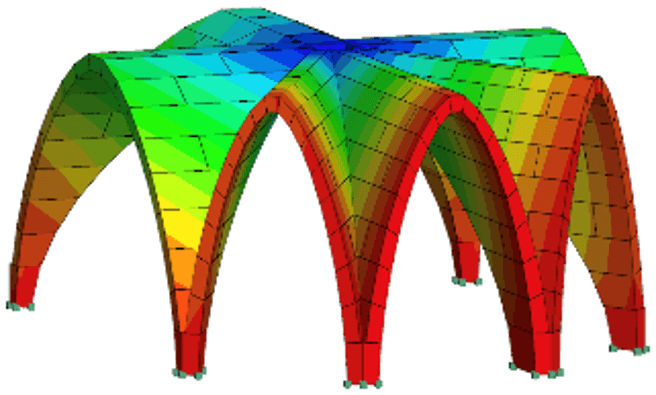
Parametric analyses of structural submodels
The first step in numerical modelling is to run benchmark models using available experimental data and standard guidelines. Reference models of vaults, walls, and spandrels will be developed, including some calibrations with available shake table tests. To carry out this task successfully, the project includes a visiting collaboration with Dr Savvas Saloustros from Swiss Federal Institute of Technology in Lausanne (EPFL, Switzerland), a leading expert in experimental masonry testing and calibration of parameters for numerical models. In addition, this collaboration will strengthen the link between EPFL and FCE and create opportunities for future joint research initiatives. After calibration, sensitivity analyses will be conducted to assess the influence of key and less certain parameters on the model results. Based on the collected data on buildings and damage, submodels of characteristic structural components will be defined according to the previously established categories A, B, and C, which will serve as the basis for parametric numerical analyses. The primary objective of these parametric analyses is to quantify the levels of damage, considering both structural damage and damage that affect specific heritage attributes. The analysis will enable the quantification of relevant response parameters, such as accelerations, displacements, and relative displacements. This process will also include the harmonization of response parameters, ensuring that the established damage criteria can be applied to finite element-based models and macroelement models. The goal is to enable the categorization of damage levels affecting valuable architectural elements and historical-artistic components. Additionally, sensitivity analyses will be conducted on the models to assess the influence of parameters on structural response, simulation accuracy, and numerical solution stability. These analyses will facilitate the optimization of model assumptions and enhance the reliability of the results. The described analyses will be performed on models with basic geometry and material characteristics, as well as on models incorporating local strengthening measures. The evaluated strengthening measures will be qualified based on their effectiveness, enabling a more refined selection of technological solutions in defining the methodology for targeted retrofitting strategies.
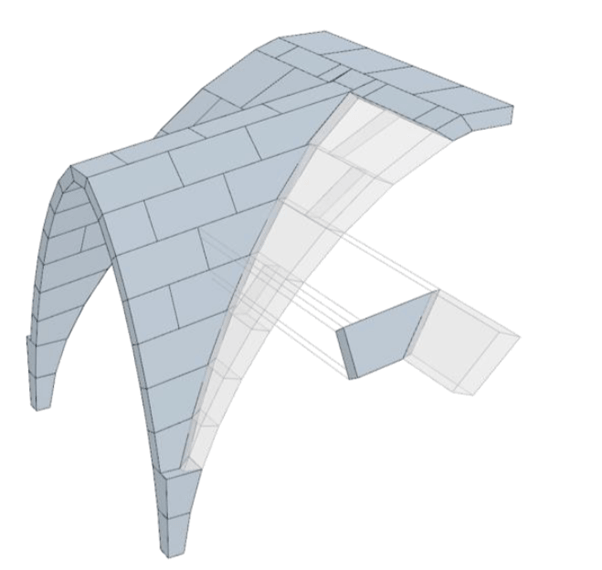
The innovation of the planned systematic analyses lies in the use of advanced numerical methods to quantify damage levels that do not only concern structural elements but also account for the degradation of original heritage values. An additional contribution of this research is the calibration of models of varying complexity, ensuring that results obtained from parametric analyses of detailed models can be applied to less computationally demanding numerical models. This will provide a more accessible tool for use in engineering practice. Furthermore, the research will produce a comprehensive review of the effectiveness of technological measures used to reduce seismic vulnerability in cultural heritage buildings, facilitating decision-making in the complex process of heritage preservation.